French Open 2026: Roland-Garros Schedule, Players, Results & Viewing Guide
Revisit Roland-Garros 2026 in Paris, including the clay-court championship schedule, leading contenders, tournament format, historical champions and international viewing information.
Sergio J. Bynum
Contributor

Revisit French Open 2026 dates, draws, leading players, clay-court tennis, tournament history and broadcast information from Roland-Garros.
The French Open has always demanded something different from tennis players. On the red clay courts of Roland-Garros, power alone is rarely enough. Matches can become tests of endurance, movement, patience and the ability to construct points under pressure.
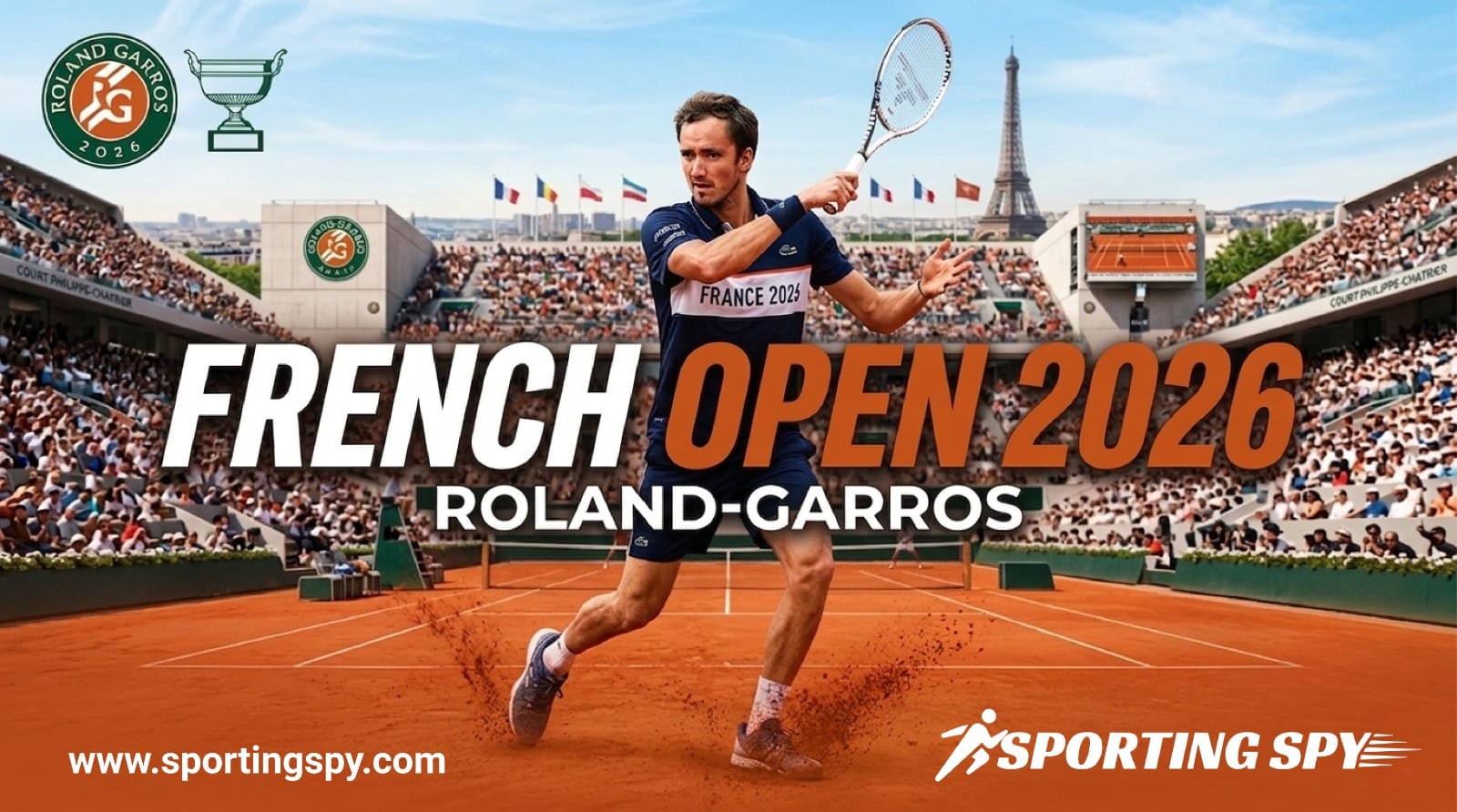
The French Open 2026 brought the world's leading players to Paris for another edition of one of tennis's four Grand Slam championships. With established champions, emerging challengers and a demanding two-week schedule, Roland-Garros remained a major highlight of the international tennis calendar.
The tournament's central storylines included Carlos Alcaraz's pursuit of continued success on clay, Jannik Sinner's growing rivalry with the Spaniard, Coco Gauff's title defense and Iga Świątek's formidable history in Paris.
This SportingSpy guide revisits the 2026 tournament schedule, notable pre-event storylines, competition format, clay-court conditions, past champions and television coverage. For definitive match results, championship winners and statistics, readers should consult the official Roland-Garros results archive.
French Open 2026 at a Glance
| Tournament Detail | Information |
| Tournament | French Open 2026 |
| Official Name | Roland-Garros |
| Sport | Tennis |
| Category | Grand Slam |
| Venue | Stade Roland-Garros |
| Host City | Paris, France |
| Playing Surface | Outdoor clay |
| Qualifying Dates | May 18–22, 2026 |
| Main Draw Dates | May 24–June 7, 2026 |
| Women's Singles Final | June 6, 2026 |
| Men's Singles Final | June 7, 2026 |
| Main Show Court | Court Philippe-Chatrier |
| Local Time Zone | Central European Summer Time (CEST, UTC+2) |
| Official Website | https://www.rolandgarros.com/ |
The schedule above reflects the tournament timeline in the original article. Individual match times and court assignments were subject to the official order of play.
What Made Roland-Garros 2026 Important?
Every Grand Slam presents a different competitive challenge, but the French Open is particularly associated with physical endurance and tactical discipline.
The Australian Open and US Open are played on hard courts, while Wimbledon is contested on grass. Roland-Garros is the only Grand Slam played on clay.
That distinction influences almost every part of the competition.
Players must adjust their footwork, anticipate the ball's bounce and manage rallies that can become considerably longer than those on faster surfaces.
The French Open also occupies an important position in the tennis season. It traditionally concludes the major European clay-court swing before players turn their attention toward grass-court competition and Wimbledon.
In 2026, several familiar names entered the tournament conversation, with considerable interest in how the leading contenders would perform under Grand Slam pressure.
French Open 2026 Tournament Schedule
The 2026 French Open main draw ran from Sunday, May 24, through Sunday, June 7, following the qualifying competition.
The opening days featured first-round matches across multiple courts. As the tournament progressed, the field narrowed toward the quarterfinals, semifinals and championship finals.
Roland-Garros 2026 Schedule by Round
| Competition Stage | Dates |
| Qualifying Rounds | May 18–22 |
| First Round | May 24–26 |
| Second Round | May 27–28 |
| Third Round | May 29–30 |
| Fourth Round / Round of 16 | May 31–June 1 |
| Quarterfinals | June 2–3 |
| Women's Singles Semifinals | June 4 |
| Men's Singles Semifinals | June 5 |
| Women's Singles Final | June 6 |
| Men's Singles Final | June 7 |
This timetable is useful for understanding the championship's progression. The actual order of play, including court assignments and match starting times, was managed by tournament organizers.
Opening Rounds: May 24–30
The first week of Roland-Garros is one of its busiest periods.
Matches take place across the main stadiums and outside courts, with numerous players competing during the opening rounds.
For spectators, this creates opportunities to watch established stars and lesser-known players throughout the grounds.
For competitors, early matches can be especially challenging. Adjusting to the conditions and avoiding an unexpected defeat are important parts of a successful Grand Slam campaign.
Round of 16 and Quarterfinals: May 31–June 3
By the second week, the singles fields become considerably smaller.
The round of 16 determines the quarterfinalists, while the quarterfinals establish the players who advance to the final four.
At this stage, recovery, consistency and tactical preparation become increasingly important.
Semifinals and Finals: June 4–7
The concluding days traditionally provide some of the tournament's most anticipated matches.
The 2026 schedule placed the women's singles semifinals on June 4, the men's singles semifinals on June 5, the women's final on June 6 and the men's final on June 7.
These dates form the final stage of the singles championship.
Men's Singles: Major Storylines Entering French Open 2026
The men's competition attracted particular attention because of the rivalry between Carlos Alcaraz and Jannik Sinner.
Their contrasting strengths, competitive intensity and high-profile encounters had made them central figures in contemporary men's tennis.
Carlos Alcaraz and His Roland-Garros Title Defense
Carlos Alcaraz entered the 2026 tournament period having won the French Open men's singles titles in 2024 and 2025.
His performances on clay had already demonstrated an impressive combination of athleticism, touch, shot-making and tactical variety.
Alcaraz's movement allows him to defend difficult positions, while his ability to change pace and use drop shots makes him especially dangerous on clay.
The possibility of another Roland-Garros title was a major pre-tournament storyline.
A third consecutive championship would have added another notable achievement to his career, although he would not have been the first man in tournament history to accomplish that feat.
Jannik Sinner and the Alcaraz Rivalry
Jannik Sinner was another central figure in the discussion surrounding Roland-Garros 2026.
His controlled baseline aggression, powerful groundstrokes and ability to take the ball early make him a formidable opponent.
The 2025 French Open men's singles final between Alcaraz and Sinner had been particularly memorable, lasting more than five hours and producing a dramatic five-set contest.
Their rivalry helped shape expectations for the following season.
However, a pre-tournament rivalry should not be confused with a confirmed final matchup. The actual 2026 draw and match results determine whether and when particular players faced each other.
Novak Djokovic's Experience
Novak Djokovic remained an important name in discussions of major championship tennis.
His Roland-Garros achievements, including French Open singles titles in 2016, 2021 and 2023, reflect his ability to succeed on clay.
Experience, return quality, movement and tactical adaptability have long been important features of his game.
Questions about his form and future were part of the broader pre-tournament conversation, but speculation about retirement should not be treated as an official announcement.
Other Established Clay-Court Contenders
Casper Ruud and Alexander Zverev were among the other established players discussed in the original tournament preview.
Ruud had previously reached multiple Roland-Garros singles finals, while Zverev's baseline power and competitive experience made him a notable figure in the clay-court season.
Their previous achievements provided useful context, although past success did not guarantee a particular result in 2026.
Women's Singles: Leading Storylines at Roland-Garros 2026
The women's competition featured its own compelling storylines, including defending champion Coco Gauff and four-time French Open singles winner Iga Świątek.
Coco Gauff's Title Defense
Coco Gauff won the 2025 French Open women's singles championship.
That victory gave her an important place in Roland-Garros history and created a new challenge entering the following edition: competing as the defending champion.
Her movement, defensive ability and competitive resilience are important strengths on clay.
However, defending a major title brings different expectations from pursuing one for the first time.
Iga Świątek's Clay-Court Record
Iga Świątek entered the 2026 season with four French Open women's singles titles, won in 2020, 2022, 2023 and 2024.
Her success at Roland-Garros has been built on excellent movement, aggressive topspin and the ability to control rallies.
These qualities have made her one of the most accomplished clay-court players of her generation.
Her history in Paris made her a natural subject of pre-tournament analysis, but historical dominance should not be mistaken for a prediction of a guaranteed victory.
Emerging and Established Challengers
Mirra Andreeva and Zheng Qinwen were also among the players discussed in the original preview.
Both represented the depth and international character of the women's game.
Grand Slam tournaments frequently produce unexpected results, and the women's draw can change rapidly as players progress through successive rounds.
The official 2026 draw and results archive provide the definitive account of how each player performed.
French Open 2026 Results and Champions
The French Open 2026 is a completed championship.
Its official records include singles and doubles champions, match results, completed draws, player statistics and tournament reports.
The source article was written primarily as a preview and does not contain a verified final results table for 2026.
Rather than reproduce predictions as facts, SportingSpy directs readers to the official results archive for confirmed championship outcomes.
Where to Find Official Roland-Garros Results
The official Roland-Garros website provides tournament information, including draws, results and historical coverage.
Readers researching the 2026 edition should look for:
- Men's and women's singles championship results
- Men's, women's and mixed doubles results
- Completed singles and doubles draws
- Match scores and available statistics
- Junior and wheelchair competition results
- Tournament reports and official highlights
Official results and tournament archive: https://www.rolandgarros.com/
A complete SportingSpy results recap should identify the verified champions, finalists and scores before making claims about the tournament's defining matches.
Recent French Open Men's Singles Champions
The French Open has been shaped by generations of exceptional players, but few have dominated the tournament as comprehensively as Rafael Nadal.
The following historical results were included in the original article.
| Year | Men's Singles Champion |
| 2025 | Carlos Alcaraz |
| 2024 | Carlos Alcaraz |
| 2023 | Novak Djokovic |
| 2022 | Rafael Nadal |
| 2021 | Novak Djokovic |
| 2020 | Rafael Nadal |
| 2019 | Rafael Nadal |
| 2018 | Rafael Nadal |
| 2017 | Rafael Nadal |
| 2016 | Novak Djokovic |
| 2015 | Stan Wawrinka |
| 2014 | Rafael Nadal |
| 2013 | Rafael Nadal |
| 2012 | Rafael Nadal |
| 2011 | Rafael Nadal |
| 2010 | Rafael Nadal |
These are historical champions through 2025, not a list of 2026 results.
Rafael Nadal's Remarkable French Open Record
Rafael Nadal won 14 French Open men's singles titles.
His achievements at Roland-Garros are among the most extraordinary records in professional tennis.
Nadal's heavy topspin, exceptional movement, competitive intensity and ability to sustain performance across long matches made him particularly successful on clay.
His dominance also provides important historical context for evaluating the achievements of subsequent generations.
Recent French Open Women's Singles Champions
The women's singles championship has also featured several remarkable periods of dominance.
| Year | Women's Singles Champion |
| 2025 | Coco Gauff |
| 2024 | Iga Świątek |
| 2023 | Iga Świątek |
| 2022 | Iga Świątek |
| 2021 | Barbora Krejčíková |
| 2020 | Iga Świątek |
| 2019 | Ashleigh Barty |
| 2018 | Simona Halep |
| 2017 | Jeļena Ostapenko |
| 2016 | Garbiñe Muguruza |
| 2015 | Serena Williams |
| 2014 | Maria Sharapova |
| 2013 | Serena Williams |
| 2012 | Maria Sharapova |
| 2011 | Li Na |
| 2010 | Francesca Schiavone |
Chris Evert's Historic Achievement
Chris Evert won seven French Open women's singles titles, an Open Era record.
Her success reflected exceptional consistency, tactical discipline and precise baseline play.
Alongside champions such as Steffi Graf, Justine Henin and Iga Świątek, Evert remains an important figure in the history of women's clay-court tennis.
How the French Open Tournament Format Works
The French Open uses a single-elimination format for its main singles competitions.
A player must win each match to advance to the next round.
The men's and women's singles main draws traditionally feature 128 players, meaning the champion must win seven matches.
Men's Singles Format
Men's singles matches are played as best-of-five sets.
A player must win three sets to win the match.
This format can create physically demanding contests, particularly on clay, where rallies may be lengthy.
Women's Singles Format
Women's singles matches are played as best-of-three sets.
A player must win two sets to secure victory.
The shorter format does not eliminate the physical and tactical demands of clay-court tennis.
Final-Set Tie-Break Rules
At Grand Slam tournaments, a deciding set reaching 6–6 uses a 10-point match tie-break, with a two-point winning margin.
In other sets, the usual tie-break rules apply when the score reaches 6–6.
This distinction is important: the final-set tie-break is not simply the same seven-point tie-break used in ordinary sets.
Qualifying Competition
Players outside the direct-entry field may earn places through the qualifying tournament.
The qualifying rounds provide opportunities for emerging competitors and established players seeking a place in the main draw.
The official entry list, qualifying draw and tournament regulations determine eligibility and advancement.
Why Clay Courts Make Roland-Garros Different
Clay is one of the most distinctive surfaces in professional tennis.
Its playing characteristics influence movement, shot selection, endurance and match strategy.
Higher Bounce and Spin
Clay generally produces a higher bounce than grass and can make heavy topspin particularly effective.
Players must adjust their positioning and timing to handle balls that rise sharply after landing.
Longer Rallies
Clay can slow the pace of play, allowing defenders additional time to retrieve shots.
As a result, points may involve several changes of direction and repeated tactical exchanges.
However, court speed and rally length also depend on weather, ball characteristics and individual playing styles.
Sliding and Footwork
Sliding is a fundamental movement skill on clay.
Players use controlled slides to reach balls and recover efficiently.
Poor movement can create difficulties even for athletes with powerful groundstrokes.
Physical Endurance
Long rallies and extended matches can place considerable demands on the body.
Players must manage their energy, recover between points and maintain concentration over multiple sets.
Tactical Patience
Successful clay-court players often build points rather than attempting to finish every rally immediately.
They use depth, angles, spin and changes of pace to create attacking opportunities.
These qualities help explain why Roland-Garros has developed such a distinctive reputation within Grand Slam tennis.
Stade Roland-Garros: The Tournament Venue
The French Open takes place at Stade Roland-Garros in Paris.
The venue includes several prominent courts and supporting facilities.
Court Philippe-Chatrier
Court Philippe-Chatrier is the tournament's main stadium.
It hosts major matches, including championship finals.
Its retractable roof allows play to continue under covered conditions when necessary.
Court Suzanne-Lenglen
Court Suzanne-Lenglen is another important show court.
It provides a major stage for high-profile matches throughout the tournament.
Court Simonne-Mathieu
Court Simonne-Mathieu is known for its distinctive architectural setting near the Auteuil greenhouses.
It offers spectators a different atmosphere from the tournament's largest stadiums.
Outside Courts
The outside courts provide opportunities to watch early-round matches, doubles competitions and a wide range of players.
Court assignments vary according to the daily schedule.
How to Watch the French Open 2026: TV and Streaming
Broadcasting arrangements are an important part of a major tennis event guide.
However, coverage rights can change, and a service available in one country may not be available in another.
The original article contains contradictory information about US broadcasting. Its later section identifies TNT Sports' rights agreement beginning in 2025, rather than the older NBC/Peacock arrangement.
United States
The original article identifies the TNT Sports broadcasting arrangement, with TNT, truTV and Max listed as coverage platforms for 2026.
Exact match availability, replays and subscription conditions should be checked against the broadcaster's official archive.
United Kingdom
The original article lists TNT Sports and discovery+ as viewing options.
Availability can differ between television packages, streaming services and tournament editions.
France
France Télévisions and Prime Video are named in the original article as major French viewing platforms.
Coverage rights, court selections and session availability should be checked through official broadcaster information.
Australia
The original article lists Nine Network, 9Now and Stan Sport.
Viewers should verify the applicable coverage and replay availability for the 2026 edition.
Canada
TSN and RDS are identified in the original source as Canadian coverage options.
India
The source lists Sony Sports Network and SonyLIV. These details require confirmation against the broadcaster's edition-specific announcements before being treated as definitive.
A Note on International Streaming
There is no single streaming service guaranteed to carry every French Open match worldwide.
Rights are divided by territory, and services may require subscriptions or other access conditions.
For reliable viewing information, consult Roland-Garros and the relevant authorized broadcaster.
French Open 2026 Match Times and Time Zone
Roland-Garros is held in Paris, which observes Central European Summer Time (CEST, UTC+2) during the tournament.
The original guide describes typical daytime and evening sessions, but individual match times should not be treated as fixed.
Matches may be delayed by weather, previous matches running longer than expected or changes to the official order of play.
For historical research, the official order of play provides the most reliable record of scheduled matches.
Attending Roland-Garros: The Fan Experience
Watching the French Open in person offers a different experience from following matches on television.
Spectators can see how players move on clay, hear the sound of the ball and experience the atmosphere of the tournament grounds.
Choosing a Session
Early-round sessions can offer access to a wide range of matches across different courts.
Later rounds feature fewer players but greater championship stakes.
Ticket Availability
High-demand sessions, particularly those involving major singles finals, can be difficult to secure.
Tickets should be purchased through official or authorized channels.
Planning Around the Schedule
Court assignments and match times can change.
Visitors should review the official order of play and allow flexibility in their plans.
Exploring Paris
For international visitors, Roland-Garros can also be part of a broader visit to Paris.
Accommodation, public transport and travel arrangements should be planned around the tournament's official schedule.
The French Open's Influence on the Tennis Season
Roland-Garros is an important part of the professional tennis calendar.
Grand Slam results can significantly influence rankings, player confidence and the direction of a season.
Ranking Points
Grand Slam singles champions earn 2,000 ranking points under the standard ATP and WTA systems.
Other players receive points according to their results and the applicable ranking rules.
The actual effect on a player's ranking depends on the points being defended, other tournament results and the ranking calculation.
Transition From Clay to Grass
After Roland-Garros, many players move into the grass-court season.
This transition requires adjustments in movement, ball bounce and point construction.
A player who has performed well on clay may need time to adapt to the different demands of grass.
Building Toward Future Grand Slams
The French Open can influence the broader narrative of the season.
A strong performance may increase expectations for later tournaments, while an early defeat may prompt changes in preparation.
Nevertheless, results at Roland-Garros do not automatically predict what will happen at Wimbledon or the US Open.
Memorable Moments in French Open History
The French Open's history extends far beyond any single edition.
Rafael Nadal's 14 men's singles titles stand as one of the tournament's defining achievements.
Chris Evert's seven women's singles titles reflect another extraordinary period of success.
Steffi Graf's accomplishments, including her historic 1988 Golden Slam, connect Roland-Garros with some of tennis's most celebrated achievements.
More recently, the 2025 men's singles final between Carlos Alcaraz and Jannik Sinner became an important chapter in the tournament's modern history.
These moments illustrate why the French Open remains such a significant championship.
Its legacy is built not only on winners, but also on the performances, rivalries and challenges that define each generation.
Explore French Open Coverage on SportingSpy
The 2026 French Open formed another chapter in the history of one of tennis's most demanding championships.
Its clay courts tested players' movement, endurance and tactical judgment, while the tournament's leading contenders brought international attention to Paris.
From the opening qualifying rounds to the championship finals, Roland-Garros remained an important stage for elite tennis.
SportingSpy helps readers explore the French Open through tournament guides, schedules, historical champions, player information, results resources and links to official sources.
For the broader history of Roland-Garros, including its venue, competition format and championship traditions, explore SportingSpy's permanent French Open (Roland-Garros) event hub.
FAQ
Frequently asked questions
When was the French Open 2026 held?
The main draw ran from May 24 to June 7, 2026, with qualifying scheduled for May 18–22.
Where was Roland-Garros 2026 played?
The tournament took place at Stade Roland-Garros in Paris, France.
What surface is used at the French Open?
Roland-Garros is played on clay courts.
When were the 2026 singles finals scheduled?
The women's singles final was scheduled for June 6 and the men's singles final for June 7.
Who won the French Open in 2025?
Carlos Alcaraz won the 2025 men's singles championship, while Coco Gauff won the women's singles title.
Who won the French Open in 2026?
The source article does not provide verified 2026 championship results. Consult the official Roland-Garros results archive for the confirmed winners and final scores.
How many players compete in the singles main draw?
The men's and women's singles main draws traditionally feature 128 players each.
How many sets are played at Roland-Garros?
Men's singles matches are best-of-five sets, while women's singles matches are best-of-three sets.
What time zone does Roland-Garros use?
Paris observes CEST (UTC+2) during the French Open.
How can I find the French Open 2026 results?
Visit the official Roland-Garros website and locate the 2026 tournament results and completed draws.
Where can I watch French Open highlights?
Official tournament channels and authorized broadcasters may provide highlights and archived coverage.
Is Roland-Garros the same as the French Open?
Yes. Roland-Garros is the tournament's official name, while French Open is its widely used English name.
Editorial Discussion (0)
Moderated Sports DiscourseNo approved comments yet. Be the first to add your perspective.